


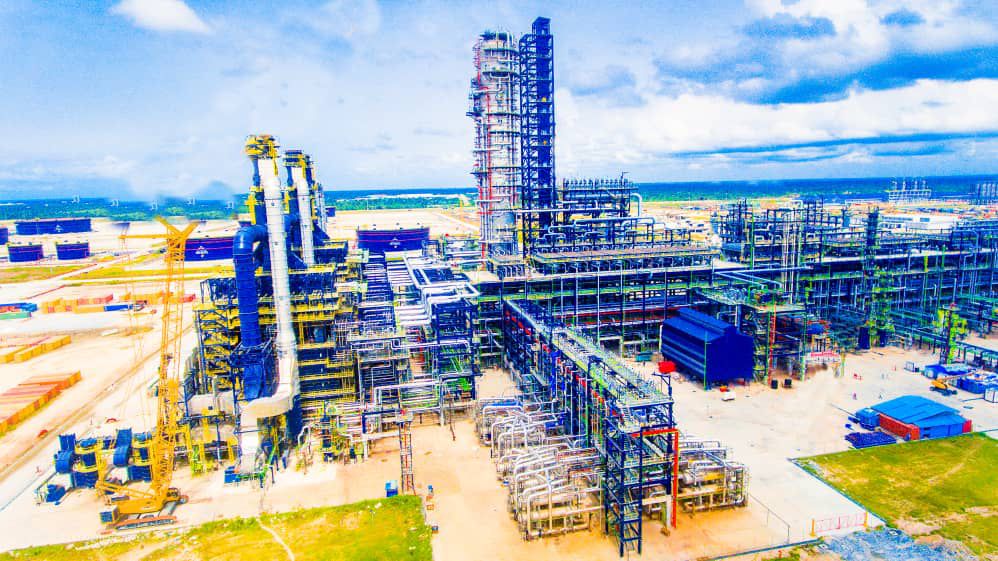
Dangote Refinery Ramps Up Maritime Expansion, Targets 600 Vessels Annually
The Chief Executive Officer of Dangote Refinery and Petrochemical, David Bird, has revealed that the $20 billion facility is scaling up its storage, logistics, and maritime infrastructure to strengthen import and export operations.
He said the refinery’s coastal siting and deep-sea access were deliberately designed to support a robust merchant model heavily reliant on shipping rather than a single crude pipeline.
Speaking to members of the Maritime Correspondents’ Organisation of Nigeria (MARCON) after a guided tour on Tuesday, Bird clarified that the refinery operates as a global merchant plant.
He noted that as production ramps up, the Dangote port is projected to handle about 600 vessels yearly, underscoring the refinery’s dependence on maritime channels for both feedstock supply and product evacuation.
Read Also:Dangote To Launch Direct Petrol Supply On September 15, Cuts Price To N820 per Litre
According to Bird, the scale of expected vessel traffic presents enormous opportunities for employment, local content growth, and logistics expansion. He stressed that the facility is not a conventional refinery tied to one crude source but sources feedstock globally and distributes refined products to domestic and international markets by sea, similar to trading hubs in Rotterdam and Singapore.
On plans to venture fully into shipping, Bird said Dangote Industries is gradually tightening control over its supply chain.
The company, he explained, has moved from sourcing vessels on the spot market to time-chartering ships and is considering outright vessel acquisition once cash flow stabilises, citing recent shipping disruptions as a lesson in the importance of vertical integration.
An engineer in the Maintenance Planning Department, Victor Ngangha Oyama, disclosed that the Dangote Port—originally constructed as a jetty for specialised equipment during the refinery’s build phase—has now evolved into a full-scale import and export terminal.
The port currently handles fertiliser exports to Brazil and other destinations, receives raw materials, and is undergoing further expansion to accommodate rising maritime traffic.
Providing additional insight, the Head of Marine, Petroleum and Petrochemical, Captain Satendra Singh Rana, detailed the refinery’s offshore infrastructure. He said the facility operates five Single Point Mooring buoys—two for crude and three for refined products—linked by 48-inch subsea pipelines.
Designed to handle Very Large Crude Carriers carrying up to two million barrels, the system enables swift turnaround times of 24 to 36 hours. With operations scaling toward 650,000 barrels per day and nearly 800 tankers already handled, Rana described the refinery-terminal combination as a transformative development in regional and global maritime energy trade.


