


By Abdulkarim Ibrahim
In a landmark move to deepen South–South cooperation and revolutionize food systems, Nigeria and Brazil have signed a historic Memorandum of Understanding (MoU) on agricultural development and food security.
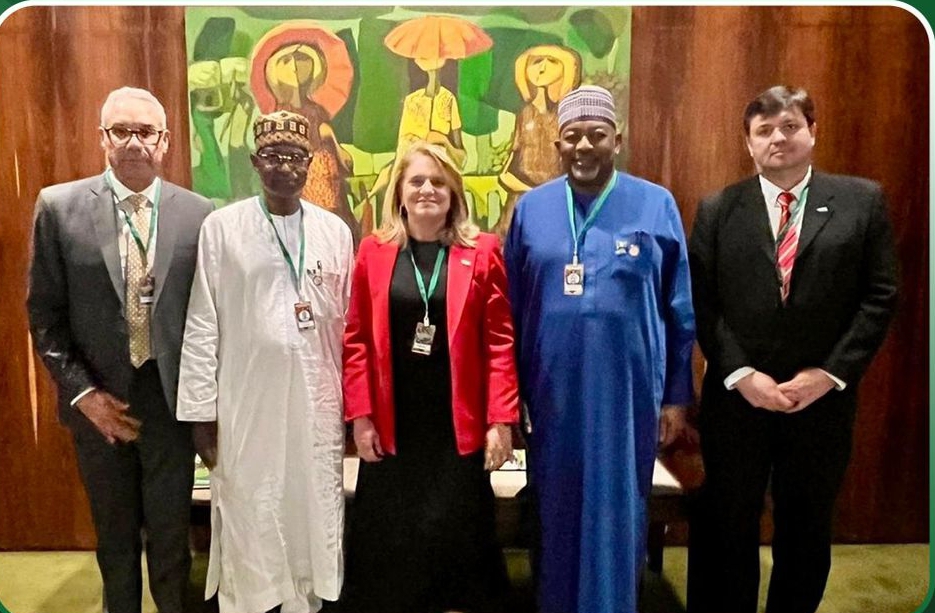
The agreement was signed on the sidelines of the II Brazil-Africa Dialogue on Food Security, Fight Against Hunger, and Rural Development, held in Brasília, where Nigeria’s Honourable Minister of Agriculture and Food Security delivered an impassioned keynote address.
Representing President Bola Ahmed Tinubu, GCFR, the Minister hailed the Dialogue as a testament to the enduring spirit of solidarity between Africa and Latin America.
“This platform affirms the strength of our partnership,” he said, “and reinforces the urgency of transforming food systems through research, development, and innovation.”
At the heart of the Minister’s message was a call for action in the face of rising population demands and climate volatility. “Nigeria’s current population of 240 million is growing rapidly. By 2050, we’ll exceed 400 million. Food security is not just a development issue—it is a matter of national survival.”
The new MoU signed between the Federal Republic of Nigeria and the Federative Republic of Brazil is a sweeping framework designed to stimulate agricultural growth across multiple fronts.
It includes collaboration on sustainable crop production, rural extension, food safety, agroforestry, livestock genetics, quarantine measures, and post-harvest processing. Key areas of focus include:
• Soybean Value Chain Development: Joint research, mechanization, and marketing strategies;
• Cassava Technology Transfer: Improved varieties and smallholder farmer training;
• Agroforestry Systems: Integration of trees and crops for soil health and climate resilience;
• Livestock Breeding and Genetics: Enhanced productivity through modern reproductive technologies;
• Sanitary Measures: Exchange of expertise in animal and plant health systems.
The Honourable Minister emphasized that the MoU builds on existing bilateral successes, most notably the Green Imperative Programme (GIP)—a flagship mechanization initiative spanning all 774 local governments in Nigeria. The GIP agreement with Brazil’s Fundação Getulio Vargas (FGV), signed in March 2024, already represents a bold effort to modernize Nigeria’s agricultural value chains and drive rural industrialization.
Beyond the MoU, the Minister spotlighted recent domestic reforms including the establishment of two new ministries for Livestock Development and Marine and Blue Economy. He also discussed Nigeria’s 2023 National Agricultural Technology and Innovation Policy (NATIP), which pilots integrated systems like rice–fish farming, promotes real-time tech adoption through the RHATAP platform, and expands aquaculture—a sector now largely led by women entrepreneurs.
“Innovation is not invention,” he declared. “It is impact. And impact only happens when science meets the soil, when data shapes delivery, and when the farmer becomes the driver of change.”
The Minister concluded by urging global partners to invest not just in trade, but in co-owned research, joint innovation hubs, and inclusive finance models. He called for shared action that transforms farms, empowers women, nourishes children, and inspires a new generation of agricultural leaders.
With the Brazil–Nigeria MoU now in force, both nations have sent a clear signal: agricultural transformation is not a future ambition—it is a present commitment.


