


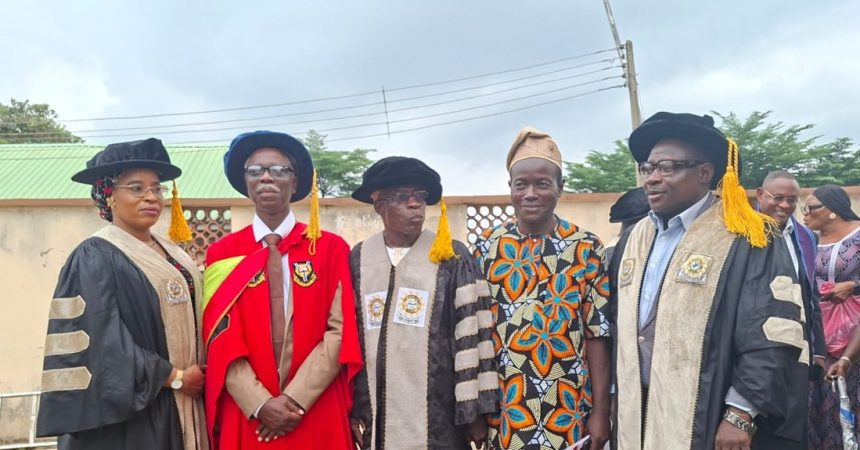
Weak Enforcement Undermines Nigeria’s Environmental Laws — Ibadan Poly Dean
Nigeria’s environmental laws cannot effectively protect the environment without stronger monitoring, compliance and enforcement, the Dean, Faculty of Engineering, The Polytechnic, Ibadan, Dr David Adewuyi Oke, has said.
Oke made the submission while delivering the institution’s 14th inaugural lecture, titled “Materials and Environment: Safer Communities from Environmental Engineering Perspective,” at the North Campus Assembly Hall.
The don identified weak monitoring and enforcement as major factors limiting the effectiveness of Nigeria’s environmental laws and regulations.
He noted that although the country had enacted several environmental laws, including requirements for Environmental Impact Assessment (EIA), the mere existence of such legislation could not guarantee environmental safety.
According to him, regulatory authorities must intensify efforts to ensure that individuals, organisations and industries comply with established environmental standards.
“We have environmental laws and regulations, including Environmental Impact Assessment requirements, but the question is: how effectively are these laws being monitored and enforced?
“That is where we need to do more. Having laws in place is not enough; there must be effective monitoring, compliance and enforcement to ensure that environmental standards are upheld,” he said.
Oke said the lecture was intended to draw public attention to environmental degradation and harmful practices that were often overlooked despite their potential consequences for the health and wellbeing of Nigerians.
He urged individuals and communities to pay greater attention to the quality of their surroundings, particularly pollution levels in homes, workplaces and communities.
The don identified noise pollution, contaminated water and oil leakage among environmental hazards requiring increased public awareness and stronger intervention.
He warned that prolonged exposure to environmental hazards could result in serious health consequences, stressing the need for Nigerians to understand the risks associated with pollution and adopt measures to minimise exposure.
Oke also raised concern over the indiscriminate felling of trees, highlighting their critical role in maintaining environmental balance.
“Trees help absorb carbon dioxide and release oxygen, making them essential to maintaining a healthy environment,” he said.
He consequently called for stronger protection of trees and improved environmental practices to promote safer and more sustainable communities.
Speaking after the lecture, Chairman of the institution’s Governing Council, Prof. Lanre Nassar, advocated stronger collaboration between academic institutions and industries to ensure that research findings were converted into practical solutions to national challenges.
Nassar, a former Rector of the institution and former Vice-Chancellor of Ladoke Akintola University of Technology (LAUTECH), Ogbomoso, said academic institutions should ensure that their research activities and curricula remained responsive to the needs of society.
He encouraged industries to participate more actively in inaugural lectures and engage with researchers to gain access to ideas, innovations and findings capable of addressing challenges confronting their organisations.
“Industry players and companies should be encouraged to attend inaugural lectures so that they can learn about new ideas, research findings and innovations that could help address challenges confronting their organisations and contribute to problem-solving,” he said.
Nassar said stronger academia-industry collaboration would help drive innovation, industrial development and economic growth.
Also speaking, the Rector of The Polytechnic, Ibadan, Prof. Taiwo Lasisi, emphasised the need to translate research outcomes into practical solutions, describing research as the foundation of several technological advancements, including artificial intelligence and renewable energy.
Lasisi said inaugural lectures offered scholars an avenue to demonstrate the impact of their research and make their findings accessible to the wider society.
“An inaugural lecture is not just a presentation; it is an opportunity for a scholar to demonstrate how far he has gone in his academic, research and innovation journey and project the outcome to society at large, so that people can learn from it and, more importantly, apply the knowledge to real-life challenges,” he said.
The speakers consequently stressed the importance of stronger collaboration among government, academic institutions, industries and communities to improve environmental governance and ensure that research and innovation contributed meaningfully to solving Nigeria’s environmental and developmental challenges.
Other dignitaries at the event included the institution’s Registrar, Dr Taiwo Olajide; Bursar, Mr Abiodun Kolawole Adegbola; Chief Librarian, Mr Olukunle Akinbola Osunrinade; Chairman of the Inaugural Lectures Committee, Mr Femi Ipadeola; academics and other invited guests.


