

Abdulkadir Bello, Dutse
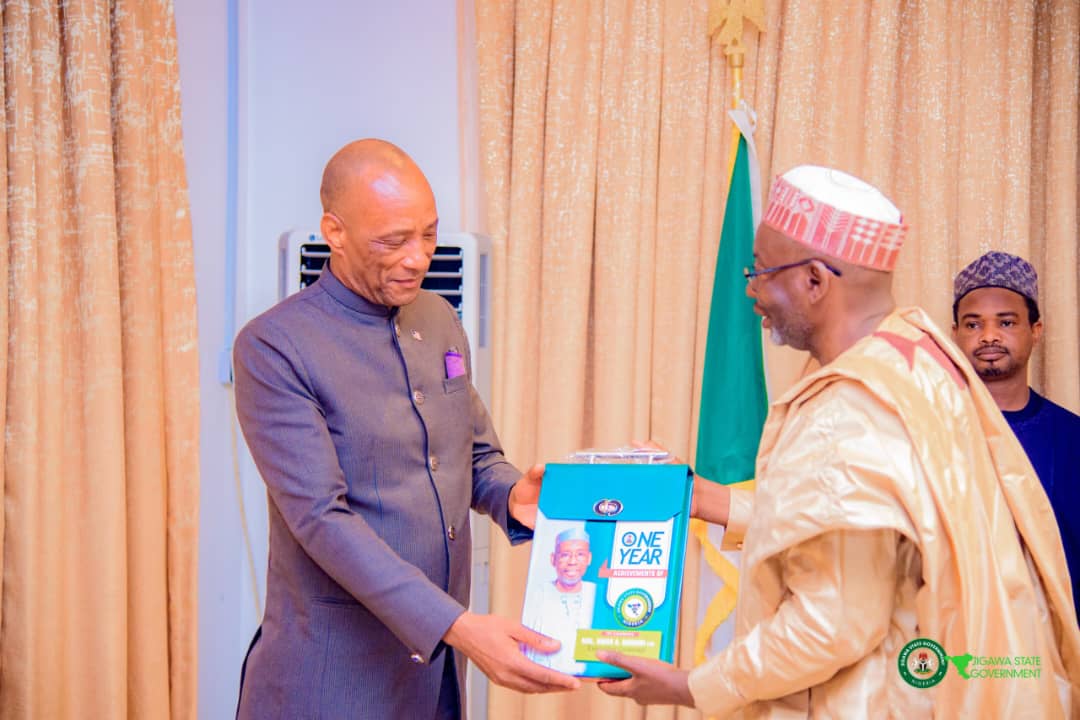
Governor Umar Namadi of Jigawa State hosted the Deputy Minister of Agriculture from the Republic of Liberia, David Akoi, for a study tour focused on rice production
Speaking during the courtesy call at the Government House, in Dutse, the state capital Mr. Akoi said the visit to Jigawa would allow his team to learn about the complexities of rice cultivation, generate experience, and gain a deeper understanding of the entire rice value chain, which he said could in the future change Liberia’s current burden of rice importation from outside Africa.
“In Liberia, rice is our staple food. We eat rice in the morning, afternoon, and night. It is not just a staple food it is a political commodity. If you ever followed the history of Liberia, in 1979, we overthrew our president, William R. Tolbert, just because he attempted to increase the price of rice. That led to the ‘rice riot,’ which subsequently led to his ouster.”
Read Also: Jigawa Targets 10 Tons Per Hectare Yields
“When we took over the government, we found that although we eat rice three or four times per day, we are not producing enough rice. In fact, we are importing 70% of the rice we consume. So, our government is determined to change that narrative, aiming to produce at least 70% of our consumption needs.”
Mr. Akoi said the president of Liberia decided to send him to Nigeria, particularly Jigawa State, instead of going far west to find solutions to his country’s rice demand.
“We are here in a peaceful study of the rice value chains and how Nigeria has managed to progress from where they were to where they are, what lessons we can learn, and how they manage to overcome the challenges.
“The simple reason we are here is to study what Jigawa has been able to do and what they have been able to accomplish so that we can take the knowledge back to Liberia to see how we can transform our rice value chains.”
Responding, Governor Namadi commended the Republic of Liberia for choosing Jigawa State for the study tour, saying that the visit would enable both parties to share ideas and benefits with each other for the success of the rice value chains.
Read Also: Gov Namadi Engages FUT Babura To Accelerate Technology-Base Education In Jigawa
He highlighted his administration’s strides in agriculture, maintaining that agriculture is the mainstay of Jigawa State’s economy.
“Agriculture is the mainstay of our economy. From the onset of our administration, we resolved that the best way to improve Jigawa’s economy and the livelihoods of our people is to improve agriculture,” he said.
“In our first year, 2023, Jigawa was cultivating no more than 60,000–70,000 hectares of rice. By 2024, we achieved over 200,000 hectares, and this year, we are aiming for close to 300,000 hectares. By 2030, our target is to produce 50% of Nigeria’s rice needs.”
“The state government believes it can only improve its economy and the people’s livelihoods through agriculture, so it’s implementing different programmes to improve agriculture.
“The state is also implementing innovative agricultural practices to combat climate change. Climate change impacts production, so the state is shifting focus from rain-fed farming to irrigation. The irrigation system is expensive, but it is paying off. We are cultivating more land by revamping the existing 10 irrigation dams in the state, which is also increasing production by over 4,500 hectares,” the governor stated.
He added that his administration purchased 300 new tractors with all the implements, 60 combined harvesters, 150 planters, and a host of other agricultural equipment to enhance rice and other crops farming in the state.
Governor Namadi said that the state’s 30 constituencies have a minimum of 10 tractors for subsidized hire services for smallholder farmers.