

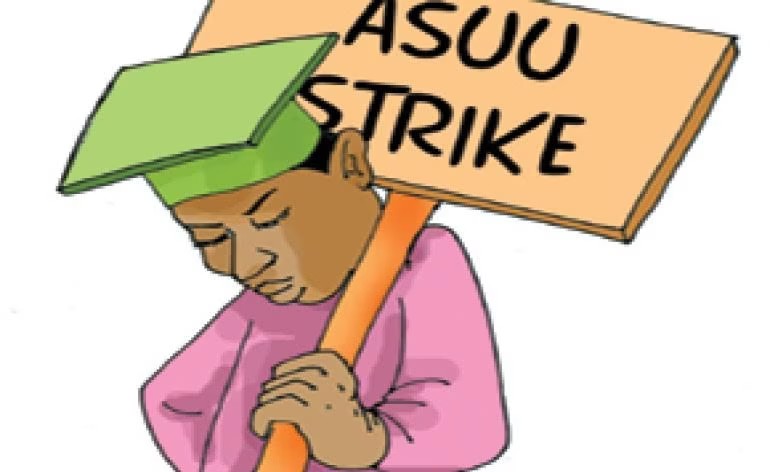
By Lamara Garba Azare
In the past decade, ASUU’s unpaid warnings and indefinite strikes have shut down public universities for hundreds of days—at tremendous cost to students, families, towns, and the nation. The most recent two-week warning strike is yet another chapter in a story of promises broken and education betrayed.
Once again, the gates of Nigeria’s public universities are shut — not by the will of teachers who love to teach, nor by students who yearn to learn, but by a government that has turned deceit into policy. The two-week warning strike declared by the Academic Staff Union of Universities (ASUU) on Monday, 13th October 2025 is not rebellion; it is a cry for justice — a moral outburst against a system built on betrayal, arrogance, and calculated insensitivity.
For the umpteenth time, the Federal Government has toyed with education, signing agreements it never intends to honour, smiling through lies, and hiding its failure behind propaganda.
This latest strike is not born of greed but of grief. ASUU’s demands are simple, patriotic, and long overdue which are: revitalization funds for decaying universities, earned allowances for lecturers who have given their lives to public service, and the genuine implementation of agreements freely entered into years ago. Yet, instead of keeping its word, the government prefers to recycle deceit — setting up committees that never commit, drafting memos that mean nothing, and appealing for “patience” from a people who have endured more than enough.
It is worthy to note that in the past decade alone, public universities under ASUU have lost over 700 days of teaching due to strikes. The longest of these was the 2020 strike, which dragged on for about nine months (roughly 270–274 days). These disruptions mean students have had semesters cancelled, academic calendars distorted, and many ambitions delayed or derailed.
At a press conference held on October 12, 2025, ASUU President, Professor Chris Piwuna, made it clear that the union had reached its limit. “There has been no meaningful progress to prevent the union from moving forward with its planned industrial action,” he declared, announcing that all ASUU branches had been directed to withdraw services after the expiration of the ultimatum.
According to him, what the government presented as a gesture of goodwill was merely a hastily prepared document — a paper without substance, a promise without soul. To Piwuna and his members, it was yet another proof that the government neither listens nor learns and therefore, the only option for the union is to go on strike.
But rather than respond with sincerity, the government reached for its usual weapon — the “No Work, No Pay” policy. A circular was hurriedly sent to vice-chancellors, directing them to conduct roll-calls and withhold salaries from lecturers participating in the strike. Such action exposes not only the government’s insensitivity but also its ignorance. The “No Work, No Pay” doctrine assumes that ASUU’s strike is about money. It is not. It is about integrity; about rescuing public universities from the ruins created by the same government now threatening to starve the system further.
Professor Piwuna dismissed the threat with calm defiance. “We don’t respond to threats,” he said. “Nobody can threaten us.” His words pierced through the fog of official hypocrisy. How do you threaten those who already endure unpaid salaries, overcrowded classrooms, broken laboratories, and the daily humiliation of teaching under roofs that leak? How do you intimidate people whose only demand is that their government should keep its word?
To buttress the efforts of the ASUU members, the Nigeria Labour Congress (NLC), in a rare show of solidarity, has thrown its full weight behind ASUU. NLC President, Joe Ajaero, condemned the government’s posturing and described the “No Work, No Pay” directive as a distortion of justice. “The breach of contract lies with the state, not the scholars,” he said. “The lecturers are willing to work, but the government, by reneging on its commitments, has made it impossible for them to do so with the dignity their profession deserves.” The NLC has warned that if the Federal Government fails to resolve the crisis after the two-week warning strike, the wider labour movement will join the struggle. Their message is clear amplifying the gospel of an injury to ASUU is an injury to all.
Indeed, every strike by ASUU is born from the ashes of broken promises. Each agreement dishonoured becomes the seed of another shutdown. Therefore, every time the classrooms fall silent, it is not a triumph of labour but a failure of leadership. For a government that boasts of reform, it is a tragedy that it cannot reform itself into honesty.
The question now is, how can a nation rise when its rulers prefer propaganda to dialogue, and intimidation to sincerity? How can we build a future when those who build minds are treated like enemies of the state?
Perhaps it is well known that ASUU’s struggle is not a battle for privilege, rather, it is a battle for the soul of education. It is a confrontation with the moral decay that defines governance in Nigeria. It is a fight against a system that celebrates ignorance and punishes intelligence — a system that starves teachers but feeds corruption. It is a protest against leaders who fly abroad for medical care and send their children overseas for schooling, while neglecting the institutions that once gave them identity. This hypocrisy is not only political; it is moral corruption and the highest form of deceit.
The strike, therefore, is not an act of defiance but of deliverance. It is ASUU’s way of reminding a forgetful nation that education is not an expense but an investment in national survival. Therefore, when the government mocks ASUU’s persistence, it mocks the very idea of a thinking nation. When it ignores their demands, it declares war on knowledge. And when it threatens “No Work, No Pay,” it reveals its poverty of morality.
The truth is harsh but clear: Nigeria’s government has lost credibility. It speaks of patriotism but kills public institutions. It talks of progress but fears enlightenment. It calls for calm but provokes anger through deceit. There is no honour in governance that cannot keep its word, no progress in policies built on lies. What ASUU demands is what any responsible government should willingly provide — a functional university system, a fair wage, and a future that does not force its youth to flee the country in search of better opportunities.
It’s regrettable to note that no university professor is earning a monthly salary of $600 compared to an average pay package of a minimum of $2000 per month per Graduate Assistant or simply put, a beginner lecturer in many countries of the world, including lecturers from smaller countries such as Niger Republic, Ghana, Kenya, Seychelles, Zambia, Uganda etc.
Estimates place the financial cost of these strikes since 1999 at about ₦1.2 trillion to ₦1.5 trillion, infrastructure degradation, lost productivity, and the ripple effects on local economies.
Therefore the current ASUU’s two-week warning strike should be seen not as a disruption but as a desperate call to conscience — a reminder that silence in the face of deceit is surrender. The union has drawn the line once more, not out of hatred but out of hope — the hope that one day, Nigeria will have leaders who understand that a nation that starves its universities feeds its own destruction.
It should be on record that when teachers strike, it is not because they hate teaching. It is because they can no longer stand the insult of a government that refuses to learn. The chalk is crying, the classrooms are empty, and the future waits — trembling — for a government that still does not listen. And if Bola Ahmed Tinubu administration continues to trade sincerity for propaganda, then history will not forget that ASUU stood firm when truth became unfashionable, and when those in power preferred deception to duty.
For when a government breaks its promises to its teachers, it breaks its promise to its people. And a nation that betrays its educators has already begun to fail its children.
Lamara Garba Azare, a veteran journalist and public affairs analyst, writes from Kano.