

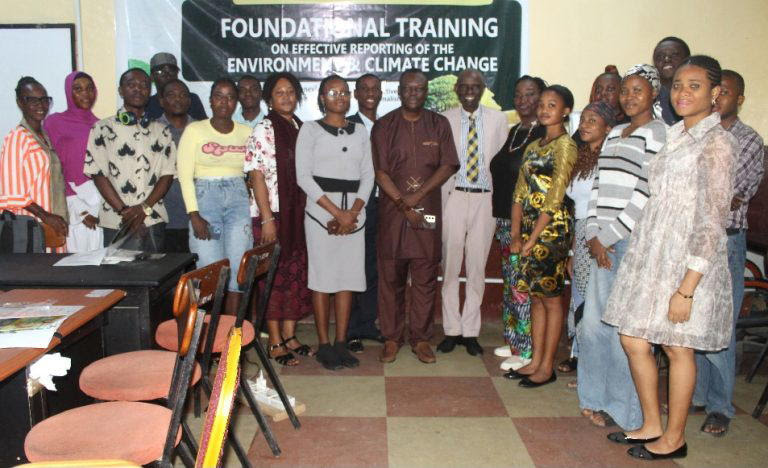
RDI, NIJ Equip Young Journalists with Skills for Climate, Environmental Reporting
The Renevlyn Development Initiative (RDI), in partnership with the Nigeria Institute of Journalism (NIJ), Lagos, has trained journalism students on practical approaches to reporting environmental and climate change issues, with experts urging greater field exposure to communities affected by ecological challenges.
The three-day foundational training, held from August 18 to 20, 2026, brought together 20 NIJ students and exposed them to key issues surrounding environmental degradation, climate change, environmental justice and sustainable development.
The programme also sought to strengthen connections between emerging journalists, environmental and climate activists, and communities directly affected by environmental challenges.
Speaking on the partnership, Executive Director of RDI, Philip Jakpor, said the initiative was designed to promote a model of environmental and climate reporting that could eventually be integrated into the curriculum of tertiary institutions across Nigeria.
He said participating students would have access to RDI’s network of environmental and climate activists, while field visits would enable them to gain first-hand knowledge of environmental challenges across the country.
As part of the inaugural programme, the trainees visited Okun Alfa, a climate-impacted waterfront community in the Ibeju-Lekki area of Lagos, following classroom sessions on various aspects of environmental reporting.
Bridging the Gap Between Theory and Reality
In his welcome address, NIJ Provost, Gbenga Adefaye, said the programme was designed to bridge a gap in Nigeria’s education system, which he noted often places greater emphasis on classroom theory than practical engagement with communities affected by climate change and environmental degradation.
Adefaye cited the drying up of Lake Chad as an example of how environmental changes can trigger far-reaching social and economic consequences, including displacement and conflicts as affected farmers and communities migrate in search of alternative livelihoods.
He expressed concern over what he described as the excessive attention given to politics by sections of the media despite the country’s numerous environmental challenges.
The NIJ provost expressed hope that the trainees would help change the narrative by producing stronger and more consistent environmental reports.
He also described the participants as fortunate to have access to specialists and practitioners with practical experience in environmental issues.
Understanding the Environment
Jakpor, in the opening presentation, titled The Environment, Our Life, explained the environment in simple terms as everything around humans that collectively provides shelter, food, water and the conditions necessary for good health and survival.
He said human activities had increasingly placed pressure on the environment, particularly through an industrialisation model heavily dependent on fossil fuels.
According to him, pollution from industrial waste, discharge into rivers and streams, vehicle emissions, deforestation, single-use plastics and indiscriminate waste disposal continues to undermine environmental health.
He said the consequences were visible globally through rising temperatures, melting glaciers, rising sea levels, extreme storms, wildfires and desertification.
Jakpor urged journalists seeking to specialise in climate and environmental reporting to take advantage of training opportunities and develop the expertise required to explain complex environmental issues to the public.
He said quality journalism could promote tree planting, responsible waste management, reduced plastic consumption, lower energy use and stronger enforcement against environmental violations.
Climate Change: The Story of a Generation
Development expert Sam Orovwuje, while speaking on Climate Change and the Environment: The Role of Journalists in Reporting the Defining Story of Our Generation, took participants through the causes and implications of climate change and environmental degradation.
He highlighted flooding in Kogi, Bayelsa and Lagos, desertification in northern Nigeria, coastal erosion in the South-West and increasing heat stress in urban centres as issues requiring greater media attention.
Orovwuje stressed the importance of accuracy and ethical journalism, noting that credibility and factual reporting were essential for journalists covering environmental issues.
He concluded his session with an exercise in which the trainees pledged to uphold hard work and ethical standards in their journalism practice.
Looking Beyond Oil and Gas
Barrister Chima Williams of the Environmental Defenders Network (EDEN) addressed the issue of extractive governance, describing oil and gas activities as having significant environmental footprints.
He also urged journalists to broaden their focus beyond the petroleum industry to other extractive activities, particularly sand mining, which he said affects communities across the country but often receives limited media attention.
Desertification and the Human Cost
Faith Nwadishi, Executive Director of the Centre for Transparency Advocacy, said many journalists enter the profession without sufficient understanding of the science, politics and human consequences of environmental issues.
She said this knowledge gap could result in shallow or inaccurate reports that fail to contribute meaningfully to public discussions or solutions.
Nwadishi described desertification as an issue connected to food security, migration, farmer-herder conflicts, gender inequality and public finance, making it an important but under-reported subject for journalists.
She explained that desertification involves land degradation in arid, semi-arid and dry sub-humid areas resulting from climatic variations and human activities.
She also cautioned journalists against using drought, land degradation, desertification and coastal erosion interchangeably.
According to her, drought is a temporary natural shortage of rainfall that can contribute to desertification but is not synonymous with it.
Nwadishi said 11 northern states were experiencing desertification and cited estimates that 43 per cent of Nigeria’s landmass is affected, with about 350,000 hectares reportedly lost annually and the livelihoods of about 40 million people at stake.
Deforestation and the Loss of Forests
NIJ lecturer Anthony Oligbo explained deforestation as the conversion of forests to other forms of land use.
He identified activities such as farming, logging, construction, mining and urban expansion among the major drivers of forest loss.
According to him, deforestation threatens forest resources, wildlife habitats, biodiversity and the broader ecological balance.
The Waste Challenge
Anthony Akpan, President of the Pan Africa Vision for the Environment (PAVE), focused on waste management, taking participants through the different forms and sources of organic waste and the relationship between organic waste, methane emissions and landfills.
Akpan argued that greater emphasis should be placed on waste reduction and reuse rather than relying primarily on recycling, which he said could involve significant energy consumption and the release of potentially harmful substances.
On waste management in Lagos, he advocated better management of organic waste from landfills and its conversion into compost for agricultural use.
He also called for improved waste sorting at household level, arguing that separating waste at the point of generation would make collection and management more efficient.
Climate Change and Women
Mfreke Asigbe, Executive Director of Cypress Global Health, examined the impact of environmental challenges on women and girls.
She explained how climate change, extreme weather events and environmental degradation can affect women’s health, safety and dignity.
Asigbe noted that women often carry responsibility for caring for children, sick people and older family members—responsibilities that can become more demanding during disasters.
She also highlighted the specific challenges faced during pregnancy, childbirth and menstruation when extreme heat, flooding and displacement disrupt access to essential healthcare and basic services.
Understanding Global Climate Agreements
Rachel Greenwood, a human rights and international development professional, took the trainees through major international environmental and climate agreements.
Her presentation traced the evolution of global environmental cooperation from the 1972 Stockholm Conference and the establishment of the United Nations Environment Programme (UNEP), through the 1992 Rio Declaration and the 1997 Kyoto Protocol, to the Paris Agreement.
Greenwood encouraged the trainees to examine Nigeria’s implementation of its Nationally Determined Contributions (NDCs), which provide an important measure of the country’s commitments towards tackling climate change.
She emphasised that developments at the international level influence national climate policies and actions.
Understanding Environmental Laws and Digital Platforms
Deputy Clerk and Permanent Secretary of the Lagos State House of Assembly, Dr. Olaosebikan Olajuwon, spoke on environmental laws in Lagos, providing the trainees with insight into the legal framework governing environmental protection in the state.
Abuja-based communications consultant Paul Ashibel addressed digital platforms for climate and environmental reporting.
Ashibel stressed the importance of accuracy and factual verification when reporting environmental issues and urged journalists to deliberately select platforms that can effectively amplify their stories and visual content.
He highlighted platforms such as Facebook, Instagram, X and TikTok as useful channels for reaching wider audiences.
Preparing the Next Generation of Environmental Reporters
The organisers said the training was intended not only to introduce students to environmental reporting but also to encourage them to see climate and ecological challenges as major journalism beats requiring sustained investigation.
By combining classroom instruction with field exposure, the initiative seeks to equip young journalists with the knowledge and practical experience needed to report the human, economic, political and environmental dimensions of the climate crisis.
The visit to Okun Alfa offered the trainees an opportunity to move beyond theory and observe first-hand how environmental changes affect communities.
For the emerging journalists, the message from the training was clear: climate change and environmental degradation are no longer distant scientific subjects. They are stories about people’s homes, livelihoods, health, food, security and future – and they require journalists who can report them accurately, ethically and from the perspective of the communities living through their consequences.