


By Uzair Adam
With the federal government’s fifty percent subsidy to farmers, under the aegis of the National Agricultural Growth Scheme and Agro Pocket (NAGS-AP) Project; the lives of young farmers like Abdullahi Shehu from Hakudau in Auyo LGA of Jigawa State have been transformed.
This subsidy has served as capital for Shehu and many others to embrace the profitable business of wheat and rice farming, turning the rich, dark soil into a canvas of possibility.
Shehu, who returned from Lagos to start farming in his hometown, believes that if these poverty-centered initiatives could be sustained and improved to about 80 percent, the issue of unemployment could be addressed.
He believes that such improvements could change the mindset of youths who move to cities in search of greener posture
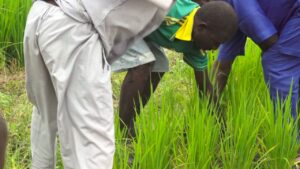
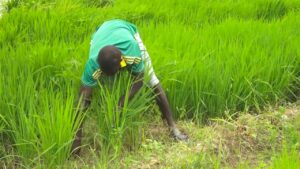
Hakudau has become one of the hubs for wheat farming in Nigeria. As the sun rises, so does the resilience and passion for farming among the farmers, who demonstrate expertise and great enthusiasm in their work.
The farmers are urging the federal government to increase the subsidy to 75 or 80 percent and also cover important materials needed by the farmers.
This support would help them realize their dreams of making Jigawa the pride of Nigeria in terms of agriculture.
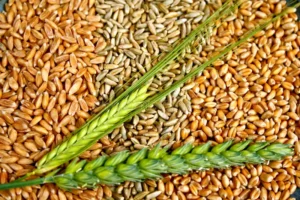
The farmers acknowledged the impact of the fifty percent seed subsidy they received from the federal government through the Ministry of Agriculture and Food Security, which led to a massive wheat harvest in the community.
They expressed their deepest appreciation for the previous program while pleading with the federal government to sustain and improve such impactful program.
The farmers hope to see the inclusion of modern equipment and different kinds of seeds for both dry and wet farming.
Farmers Urge for Enhanced Seed Subsidy
The farmers passionately called on the federal government to continue the subsidy and increase it to either 70 or 80 percent.
They believe that with this level of support, farmers in Jigawa State could help provide food security not only for Nigeria, but for the entire African continent.
Their appeals came after a surprising bumper harvest of wheat, following the exceptionally good seed subsidy provided by the federal government through the Ministry of Agriculture and Food Security.
They extended their gratitude to the Minister of Agriculture, Abubakar Kyari, for the transformative initiatives that have improved farming practices.
They are now requesting an improvement of the program to cater for about 70 or 80 percent subsidy to farmers.
Malam Hasan, also known as Tela, is among the farmers who advocate for the continuation and enhancement of the program, hoping for a more substantial harvest than last year.
“This program has transformed the lives of many farmers in this community. I know people who borrowed money to cultivate their lands, but this program has served as their capital, allowing them to stand on their own,” he said.
He added, “We are pleading with the federal government to sustain this program and to increase the subsidy to 70 or 80 percent to achieve a more substantial harvest this year.
“If only people in Auyo LGA could receive such a subsidy, we could feed all 36 states of Nigeria,” he added.
Muhammad Sani also pleaded for the continuation and improvement of the program, stating, “We want the program to cover more farmers as it did before.
“This has helped in boosting our farming and provided job opportunities to many people who do not have the capital to start farming.”
Another farmer, Musa Usman, echoed the same plea, urging the government to expand the program to cover other essential farming materials, as one of their challenges is the lack of modern equipment for farming.
Muhammad Hamza praised the previous efforts, describing Minister Kyari as a visionary.
He emphasized that, “Farmers need this kind of support to grow. We are pleading with the federal government to increase the subsidy to 80 percent next time.”
“This, I believe, will change the future of not only wheat farming but also rice farming in Nigeria,” said Malam Hamza.
The National Agricultural Growth Scheme and Agro Pocket (NAGS-AP) Project, was supported by a $134 million loan facility advanced to Nigeria by the African Development Bank, increasing hope and food security in the Africa’sg iant economy
Project Description
This intervention aims at combining the effect of increased productivity, increased cropping intensity and expansion of production areas.
This will help to increase the volumes of locally produced foods that will in turn improve household and national food security, build resilience to external shocks and safeguard livelihoods to the benefit of the economy.
The Program consists of four (4) mutually reinforcing components which includes Agriculture Sector Reforms, Improvement in Delivery of Farming Inputs and Quality Extension Services, Support to Wheat Production as well as Enhancement of Private Sector Participation in Production of Agriculture Inputs.
Objectives of The Program
The project objective is to build the resilience of small holder farmers through increased access to inputs and increase food and nutrition security.
The Program will support the FGN policy of providing enhanced access to quality and affordable agricultural inputs to 5 million farmers targeted by NAGS.
Specifically, the Program will provide about one one million of the targeted NAGS small holder farmers with improved climate adapted agricultural production technologies, including certified seeds of heat tolerant wheat, drought tolerant maize, high yielding rice and soybean varieties, fertilizer and agro-chemicals, as well as extension services, to at least double their average yields.
The scheme was unveiled in 2022 and will last for the period of five years by December 2027