

By Abdulkarim Ibrahim
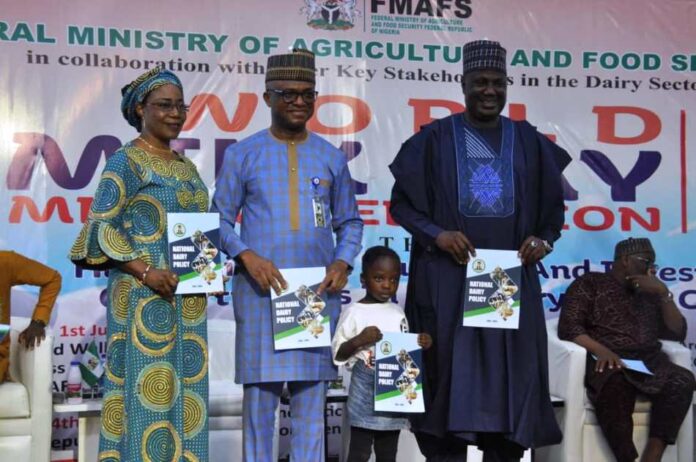
The Federal Executive Council, FEC has approved the National Dairy Policy framework as imperative step to guide public and private interventions and investments in the Nigerian dairy industry
The document, the first in Nigeria, which is formulated to promote synergy among actors in the dairy industry, is a collaborative effort of stakeholders drawn from the Federal Ministry of Agriculture and Food Security and Ministry of Trade and Investment.
It is a robust set of guidelines that provide an encompassing regulatory and institutional framework that underpin how dairy business should be done in the context of the Nigerian socio-economic environment. 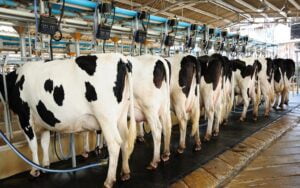 The Policy is consistent with the federal government’s strategy to catalyse development in the livestock and dairy sectors in order to achieve sustainable diversification of the national economy, a key objective of its National Development Plan (NDP) 2021 – 2025.
The also policy covers and supports the core dairy value chain, which includes production, aggregation, processing, packaging, distribution and marketing.
It also covers supporting functions of the dairy value chain, including infrastructure, farm mechanization, cold chain facilities, logistics, research and development , extension services and market information technology among others.
Other areas covered in the policy include strategic interventions and rules augmenting the dairy value chain.
According to the document, Nigeria’s population is estimated to reach about 400 million by the year 2050, and food security is critical to maintaining a stable, cohesive and secure country.
“This reality suggests that the current high dependence on imports for the food needs of Nigerians must be curtailed and such would be achieved largely by viable investments in agriculture to boost productivity and sufficiency.
“Livestock farming which includes dairy production remains a sector of interest and highly strategic to economic diversification and food security.
“However, the sector’s contribution to Nigeria’s total agricultural output is significantly low and this calls for strategic actions to catalyze sustainable development”. It emphasised. 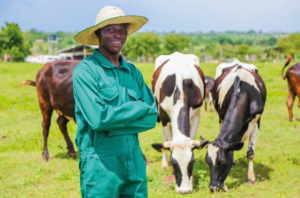 Agriculture presently contributes about 25% of GDP, and the Federal Government desires to increase its contribution to 45%. Also, agriculture provides 27.9% of the total employment in Nigeria. Livestock farming contributes about 1.9% to Nigeria’s agriculture.
Policy Mission and Vision
Wind Flow checks revealed that the document is a compendium of stated goals aimed at enhancing agricultural productivity especially in the diary industry
It stated that “the vision of the policy is to provide a policy framework that guides public and private sector interventions and investments in the Nigerian dairy industry to expedite the attainment of self-sufficiency in milk products and global competitiveness.
“The mission is to create an enabling environment that enhances innovative and technology-driven investments by smallholder producers and private sector operators in the Nigerian dairy industry.
“The goal is to provide a framework and guiding principles for the development of efficient and sustainable dairy industry to satisfy national and international
requirements for milk and its products”. The document added
Objectives Of The Policy
Among the objectives of the policy, the 48-page document stated “is to expand production and productivity of smallholder and commercial dairy farmers through support in extension, access to finance and development of infrastructure.
“Provide incentives for backward integration in the milk collection, aggregation, and processing through investments in cold chain services, efficient transportation and access to finance.
“Provide a robust and effective institutional framework by establishing a Dairy Development and Marketing Board with a mandate to collaborate with relevant stakeholders to drive the sustainable development of the dairy industry”.
“Pursue deliberate awareness and engagements to support the attainment of the vision and goal of the policy with active participation of public and private sector players”. The document concluded