

By Uzair Adam
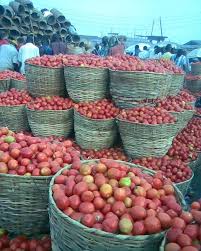
The price of tomatoes has dropped significantly in Lagos and other parts of Nigeria due to the ongoing harvest season, resulting in a glut.
Farmers attribute the situation to the excess supply of tomatoes, which has caused prices to plummet.
Wind-Flow has gathered that a tomato glut occurs when supply exceeds demand, typically leading to a price decline.
This phenomenon is an annual occurrence in Nigeria between January and March, coinciding with the harvest season.
Currently, a 50kg basket of tomatoes sells for as low as N10,000 to N12,000 in some northern states, while a 25kg plastic crate is priced between N6,000 and N7,000.
In Lagos, the price of a big basket ranges from N13,000 to N15,000, a sharp drop compared to the N140,000 to N150,000 recorded in May 2024.
Rabiu Zuntu, Chairman of the Tomato Growers and Processors Association of Nigeria (Kaduna State Chapter), attributes the price drop to the seasonal harvest.
He urged consumers to take advantage of the low prices by preserving tomatoes for future use.
“One of the major challenges in the tomato sector is the high rate of post-harvest losses during this glut period, which accounts for almost 50 percent of the produce.
This is largely due to a lack of storage facilities, cold rooms, and processing technologies,” Zuntu said.
He encouraged households to adopt small-scale preservation methods, such as blending, boiling, and storing tomatoes in airtight jars, which can keep them fresh for up to six months.
He also noted other preservation methods, like burying tomatoes underground in humid conditions, though these techniques may not suffice for large-scale needs.
In Lagos, traders at major markets confirmed the price drop and advised consumers to stock up.
At the Mile 12 Market, a 50kg basket sells for N15,000 to N20,000. However, premium-quality tomatoes are still slightly pricier, selling between N35,000 and N37,000.
“Tomatoes are in abundance now, and prices are favorable. I advise customers to buy and preserve for the future,” said Queen Oloyede, a trader in Surulere.
Consumers have also shared their experiences. Catherine Eigbedion, a resident of Agege, highlighted the challenge of inconsistent electricity for preservation.
“If I knew alternative preservation techniques, I would buy more tomatoes in bulk,” she said.
Another consumer, Ebere Dudu, praised the affordability of tomatoes but expressed concern about fluctuating prices in the coming months.
“This is the time to preserve as much as possible,” she said.
Similarly, Queen Akpan noted the benefits of the current abundance. “If I can afford to buy in bulk, I will, so I can save money for the days when tomatoes become expensive again,” she said.
Farmers and traders are optimistic that consumers will maximize this period of abundance to reduce waste and prepare for the inevitable scarcity later in the year.