

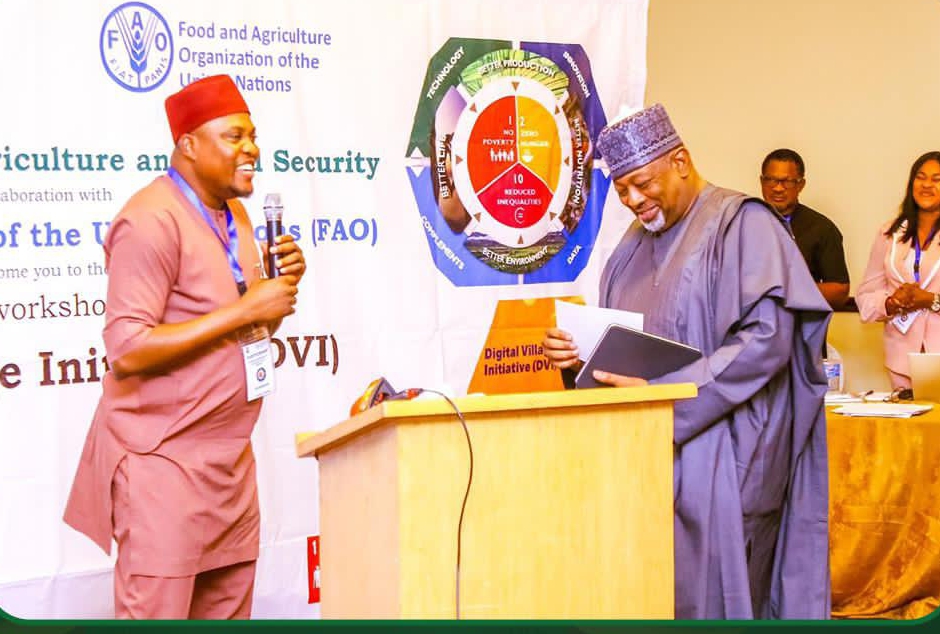
In a significant step toward revolutionizing agriculture in Nigeria, the Honourable Minister of Agriculture and Food Security, Senator Abubakar Kyari, CON, officially launched the Inception Workshop of the Food and Agriculture Organization’s (FAO) Digital Village Initiative (DVI) in Lagos on May 8, 2025.
The workshop, themed around driving innovation and digital inclusion in agriculture, marks the beginning of a comprehensive plan to digitize Nigeria’s agricultural sector and empower rural farming communities through cutting-edge technologies.
In his address, Senator Kyari emphasized that the DVI aligns seamlessly with President Bola Ahmed Tinubu, GCFR’s Renewed Hope Agenda and national commitment to end hunger by leveraging innovation and technology. “We are irreversibly committed to using digital tools to deliver prosperity to Nigeria and ensure that no Nigerian goes to bed hungry,” the Minister stated.
He highlighted the role of artificial intelligence, geospatial mapping, data analytics, and mobile platforms in improving agricultural productivity, reducing waste, and building resilience. With the global digital agriculture market projected to reach $60 billion by 2034, Senator Kyari positioned Nigeria to harness this momentum through strategic partnerships and national digital platforms.
A key component of Nigeria’s strategy is the establishment of a National Integrated Digital Agriculture Platform, designed to link all players across the agricultural value chain—from farmers and researchers to retailers and consumers. The platform will serve as a “digital nervous system” to facilitate data-driven planning, climate-smart farming, efficient logistics, digital finance, and market access.
Senator Kyari also announced a groundbreaking partnership with the National Identity Management Commission (NIMC) to authenticate the national farmer registry using the National Identification Number (NIN). A pilot project is already underway in Nasarawa State, with plans to expand nationwide. “This is a critical step towards building a world-class farmer identity management system,” he said.
The Minister reaffirmed the government’s commitment to ensuring that every Nigerian farmer benefits from digital inclusion, stating that technology is no longer a luxury, but a necessity in achieving food security and economic growth.
Expressing gratitude to the FAO for their leadership and technical support, Senator Kyari urged all stakeholders to actively engage, collaborate, and contribute to the success of the Digital Village Initiative. “Together, we can transform agriculture from subsistence to sustainability, from isolation to integration, and from vulnerability to value,” he concluded.
The FAO Digital Village Initiative is set to create a new era for Nigerian agriculture—where digital innovation becomes the foundation for prosperity, resilience, and national food sovereignty.