


BY Adamu Aliyu Ngulde, Maiduguri
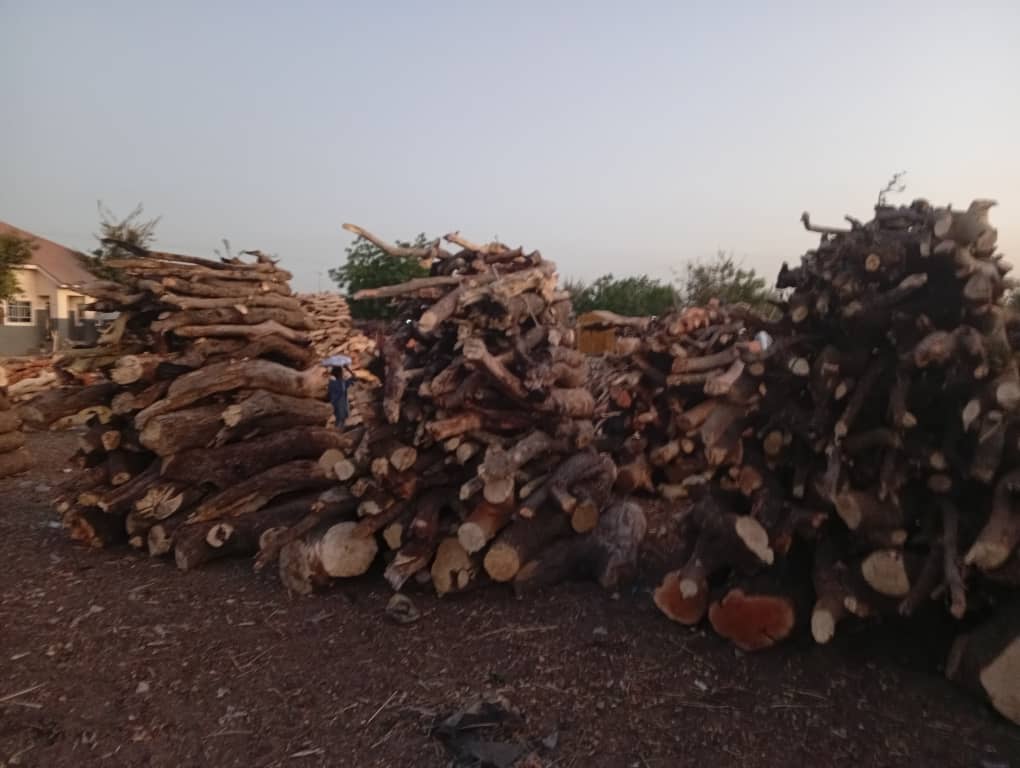
Following the concerns surrounding deforestation, the Borno state government instituted a total ban on both the manufacture and importation of charcoal. Still the trees continue to fall. Why?
As he finished his dawn prayer, 63-year old Ba Maidugu Ali prepared himself to move. While getting ready, he picked an axe, a bag that had two clothing sets, some garri and other basic things. He greeted his family and left for the crowded Benisheikh motor park in North East Nigeria, carrying these on his shoulders.
Before leaving for his voyage, he had bought sufficient provisions for his family for a minimum of two weeks so that their basic requirements were fulfilled while he went in search of earning their livelihood.

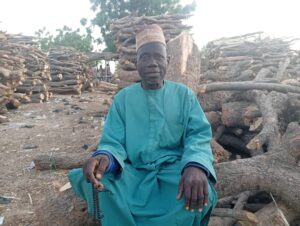
At the motor park, along Damboa road Maidugu a 40-year old Falmata Ali Muhammad and her companions, a group of ten women, who were all coming back from the forest of Damboa local government area of Borno State, Northeast Nigeria.Three vehicles arrived, and the passengers hurried to board them. While Amodu and his companions headed eastward towards the Konduga forest, the others departed westward towards Damboa. They would spend about 20 days in these forests, felling trees to make charcoal.
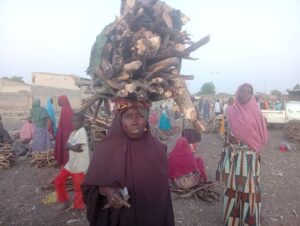
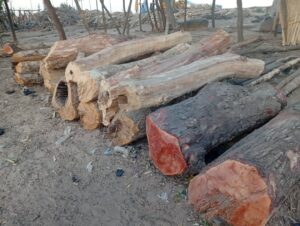
“After we have gone into the forest, our first task is to identify mature trees for cutting. We then chop them off into logs and transport them to a secure area.
“Afterwards, we arrange these logs into a tower and cover them with mud to make a hill. Finally, we ignite it and let it burn steadily for at least three days,” Amodu explained, detailing the charcoal production process.
The practice of charcoal production is detrimental to the environment, especially because it involves deforestation. The extensive felling of trees leads to the loss of thousands of hectares of fertile land. The cleared lands become vulnerable to erosion caused by wind and water, ultimately disrupting the soil structure and rendering it unsuitable for agriculture.
Additionally, charcoal production exacerbates climate change and poses a threat to biodiversity. The reduction of forest cover diminishes the capacity for carbon absorption and contributes to the release of previously stored carbon, further exacerbating climate change.
Between 2001 and 2022, Borno state experienced a significant loss of tree cover, amounting to 28 hectares, which represents a 66 percent decrease in tree cover since 2000. This deforestation contributed to the emission of approximately 12.9 kilotonnes of carbon dioxide, as reported by Global Forest Watch, a forest-tracking platform.
The primary drivers of this alarming trend include the longstanding Boko Haram insurgency, which has spanned over a decade, as well as the activities of charcoal producers like Amodu.
The increasing rates of environmental degradation prompted the state government in 2017 to ban the sales of charcoal and firewood in Maiduguri, the state capital.
Although renewed in 2021, the ban has failed to deter deforestation in the state as the charcoal industry keeps booming.
Were Amodu and his peers unaware of the ban? Was there no implementation? Or were they simply ignoring it out of necessity?
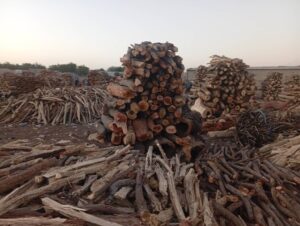
Maidugu is aware that falling trees causes deforestation and negatively impacts the environment. However, he confesses that they cannot stop, saying “if , we do, our families will starve.”
Amodu, who is a native of Konduga local Government area of Borno State, Northeast Nigeria further said, “Prior to the insurgency, charcoal business was something strange to us in our villages. We didn’t know how it was produced, nor did we use it in cooking. We used to hear about it from other places.
“It was after we were displaced that we learnt to make a trade out of it for survival.” Maidugu told Win-Flow News.
The activities of IDPs have since contributed significantly to the disappearance of trees to the extent that, people now have to trek for much longer before sighting trees that can be cut down for firewood and charcoals.“The charcoal presently is mostly from smaller trees and scrubs. The forest is barren”
“Big trees keep getting hard to come by. They can only be obtained in Boko Haram-controlled territories like Alagarno axis. The sad thing is that even if three out of ten of us are killed today in the forest by the terrorists, the remaining seven will return in a few days.”
“However, they are lenient in their approaches. They seem to understand that we have lost our means of livelihood to the Boko Haram insurgency, and firewood is our only present means of sustenance.”
A Director of agriculture in one of the state’s local government areas explained that, forest guards are sometimes unable to go as deeply into the forest as the charcoal producers because they may be attacked by insurgents.“This is why monitoring the activities of these people is difficult sometimes,” he said. He added that, another challenge is they have not received a clear directives from the state government to enforce the ban. They only heard of it in the news.
“What is usually done is that, directive would be given to the head of the agriculture department through the chairman of the local government. Then we would invite the Village heads and Ward heads as well as community leaders and sensitise them on the effects of deforestation and then announce the penalties for defaulters. They will in turn inform their community members. ”This shows that a gap in how the policy is communicated may have also been impeding the ban’s implementation.
“If someone transports logs of trees into the town, the government agents mostly fine them. However, if the logs are burnt into charcoal in the forest before being taken to the town, they don’t talk, Maidugu revealed.
He added that, they have union leaders who checkmate their activities and serve as a bridge with the government. Loggers in Borno are restricted from felling economic trees like Tamarind, Verging maiden and desert date.
Defaulters, according to him, are fined between six ₦6,000 and ₦10,000.
Babagana Alhaji, a forest guard at the Chad Basin National Park, said when people are caught in the forest, they first try to understand their true intentions, confirming whether they went to log or hunt games.
“Depending on the offence and its gravity, you either fine them there or take them to court or both. If such a person is to be fined, the minimum is ₦5,000, and it can be up to ₦50,000, depending on the offence. And if such a person is to be jailed, he can get up to 15 years.”
Ahmadu Mafa, a Permanent Secretary at the Borno State Ministry of Environment, earlier disclosed to newsmen that loggers are fined ₦500 per tree, observing that the penalty is too low to deter repeat offences. Maidugu said, the irony is that the charcoal producers have continued to generate revenue for the state government. He further said, they pay a levy of ₦500 per vehicle to the Borno State Internal Revenue Service.
Babakura Musa, a charcoal merchant, revealed that when they are moving charcoal into Maiduguri, the security agents at the entrance let them pass after taking bribes.
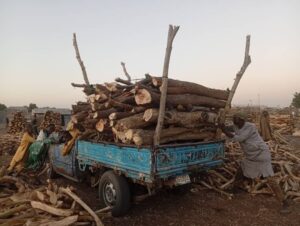
Amodu mentioned that, two able-bodied youths can produce at least twenty to forty vehicles of wood in the bush.
Daily. At least six pick-ups trucks, carrying 20 to 40 bags each, will go into town. A bag of charcoal is bought by the merchants at ₦5,000 in the forest and resold at ₦8,000 in the town.
When Windlow News contacted Muhammed Waziri, a Professor of Geography at the University of Maiduguri, said, “the charcoal ban could not be effective for two major reasons. Number one, the livelihood. The people who depended on that have no other source, and the government has not provided anything for them. Number two, other sources of fuel, such as kerosene and gas, are very expensive; they are beyond the reach of the poor man. So, the government has made the mistake of not providing an alternative to charcoal for the people to use.
”So, how does this further fuel deforestation?“ It is obvious, If you go round the state, especially the central and northern parts, you can go kilometres without seeing a tree standing,” Prof. Waziri stated.
This implication of this is a contribution to climate change as it, “opens the place to heat, wind, etc. without any barrier. Trees normally protect the environment from harsh wind and even provide oxygen that is needed for human consumption.”He added
Other consequences include reduced rainfall, increasing windstorms, and low agricultural productivity.To effectively implement the ban, he suggests that the government carry out sensitization campaigns to let people understand the long-term adverse effects of their habits.
“So, if people are sure that what they are doing is not good enough, they will start adapting to sustainable alternative sources.
Meanwhile, we have to enforce it. Anybody unnecessarily cutting down these trees, especially fresh ones, should be punished. Waziri sees options like maize, sorghum, millet stalks, sawdust, cow dunks, and waste papers as short-term alternatives. “And if we must use trees, we should replant them, or there should be a tree garden where trees will be planted for fuelwood exploitation as a long-term alternative.
The government can also connect with NGOs or invite individuals to provide alternatives such as charcoal briquettes from animals and other wastes.”


