


By Abdulkarim Ibrahim
About one third of global food production is either squandered or spoiled annually, before it get to the consumers, according to a report by the UK Foods Standards Agency.
The report also revealed that the high-Income countries waste as much food as Sub-Saharan Africa produces.
The COVID pandemic has shown the fragility of our global food supply chains, with many supermarkets and restaurants in almost every country having experienced food shortages.
Millions of people in the UK alone have experienced severe food insecurity during COVID-19, according to a recent report by the country’s Foods Standards Agency. But food shortages were prevalent long before the pandemic.
At the same time, one-third of all food produced each year globally is squandered or spoiled before it can be consumed. Research also suggests that high-income countries waste as much food as sub-Saharan Africa produces.

This food waste then ends up in landfills to rot, which releases greenhouse gases. And when this is combined with the amount of energy it takes to produce, manufacture, transport and store this food, it contributes a staggering 3 billion tonnes of carbon dioxide to our planet.
To put that in context, if food waste was a country, it would be the third-highest emitter of greenhouse gases in the world, after the US and China.
But the good news is there are numerous techniques, technologies and policies that together could help reduce global food waste at every point in the process of production and consumption.
Why is food wasted?
According to the Food and Agriculture Organisation for the United Nations, lack of infrastructure, limited knowledge on storage and food handling, combined with unfavourable climatic conditions, can lead to lots of food spoilage and waste in low-income countries.
On the other hand, in high-income countries, aesthetic preferences and arbitrary sell-by dates mean food easily becomes waste.
Cosmetic blemishes, produce that is too ripe, too big, too little or even the wrong shape can lead to perfectly good fruits and vegetables going to waste.
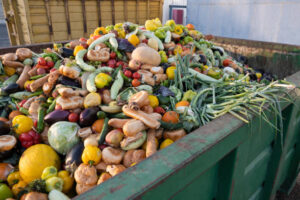
Supermarkets throw out massive amounts of peppers, cabbage, cauliflower, parsnips, lettuce in rubbish bin, as ‘waste’ food every year.
As the global population continues to increase, it places real pressure on world food production. Indeed, the industry will need to grow by at least two-thirds by 2050 to ensure adequate nutrition for everyone in the world.
Yet, despite the dire need to become more resourceful, food waste and loss is at an all-time high, making it clear that unless prompt action is taken, food shortages will soon become a long-term reality.
What can be done?
The key to tackling this issue is to have a resilient and resourceful “farm-to-fork” approach to help reduce food waste and to ensure the future of food security.
Collaboration with food producers and more investment in technological applications and overall infrastructure at the earlier stages of the food supply chain can drastically reduce food waste and loss in low-income countries.
This is important because plant diseases and pests, along with poor harvesting techniques can be a big factor in the high levels of food waste at this point in the food supply chain.
Also, powered drones can help farmers become more resourceful and reduce the overuse of pesticides in food production.
This is important because pesticides can adversely affect the food ecosystem. They pollute water, deplete soil fertility and contaminate turf, all of which can result in food loss and waste.
This approach also enhances crop yield and reduces operational costs as well as improves the health of livestock is also better for the environment.

A big part of the food waste problem is changing how we shop and view food and our mindset around what constitutes waste.
But research shows the best way to tackle food waste among consumers is to highlight the potential money that can be saved as well as the “feel-good factor”, or moral value, of doing a good thing for the environment.
A recent study with households in London, UK and Ontario, Canada, found that a two-week money-based intervention called “reduce food waste, save money” helped participants to throw away 30% less food. Participants were given local information on food waste and costs, along with tips on how to improve food planning, efficiently purchase, store, and prepare food and how to use leftovers to create new meals.
Similarly, new technology can help commercial kitchens reduce food waste by directly connecting behaviour changes to increased profits. For example, the Winnow software system calculates the costs of discarded food, correlating food waste to sales.
A more creative approach to food waste comes via a circular food system, which prevents food waste from being discarded. It can, for example, be converted into renewable energy.
Waste can even be transformed into more food for humans (for example, tofu from leftover soybeans), as well as animal feed.
While the problem of food waste can feel quite out of your hands as a consumer, there are things you can do to help.
Things like supporting businesses or restaurants that use waste foods in their products or meals. Planning your meals around sell-by dates. Not throwing out food if it is a bit wilted or bruised and only buying what you need, especially on special occasions where food can often go uneaten and to waste.
Ultimately, it is not going to be any single thing that solves food waste, but a collective approach can enable us to make the changes that need to happen.


