


Sanusi: Nigeria’s Energy Crisis Biggest Barrier To Industrialisation, Economic Growth
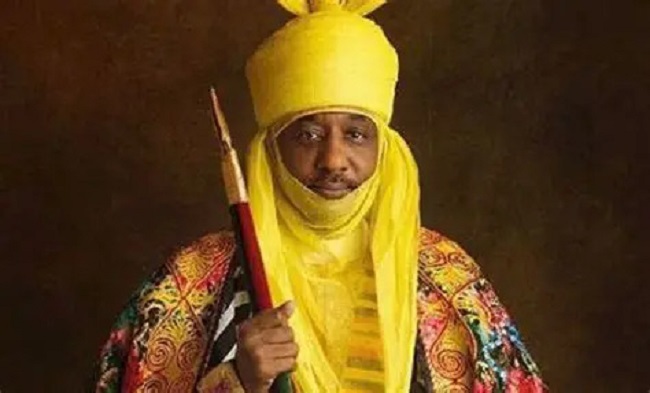
The Emir of Kano, Muhammadu Sanusi II, has described Nigeria’s persistent energy deficit as the country’s greatest obstacle to industrialisation, economic growth and sustainable national development, urging urgent reforms to transform the power sector.
Speaking on Friday at the birthday symposium of former Minister of Power and Chairman of Geometric Power Group, Prof. Barth Nnaji, held at the International Conference Centre (ICC) in Enugu, Sanusi said no nation could achieve meaningful economic progress without reliable, affordable and sustainable electricity.
Delivering the keynote address, the Emir stressed that energy security remained the cornerstone of national development, noting that stable electricity supply drives industrial expansion, boosts productivity, creates jobs and reduces poverty.
“Energy security and national development are inextricably linked. A reliable, affordable and sustainable energy supply is the foundational driver of economic growth, industrialisation and poverty reduction,” he said.
Sanusi explained that countries plagued by unreliable electricity inevitably suffer low productivity, high production costs and weak socio-economic development. He noted that affordable and dependable power enables businesses, from small-scale enterprises to large manufacturing firms, to operate efficiently and plan for long-term investments.
Citing data from the International Monetary Fund (IMF), the former Governor of the Central Bank of Nigeria (CBN) said energy security plays a critical role in macroeconomic stability, industrial competitiveness and inflation control, warning that even brief power disruptions could slow economic growth while driving up inflation.
He further emphasised that reliable electricity is indispensable to critical sectors such as healthcare, education, information and communication technology (ICT), transportation and other essential public services, warning that Nigeria risks being left behind in the global transition to electric vehicles if the country’s energy challenges remain unresolved.
The Emir advocated an energy transition strategy that leverages Nigeria’s abundant natural gas resources while significantly expanding investments in renewable energy sources, particularly solar and wind power.
According to him, the country’s prolonged electricity crisis has fuelled poverty, unemployment and the rising cost of living, while forcing households and businesses to depend heavily on generators that contribute to environmental pollution.
Sanusi identified chronic underinvestment, vandalism of power infrastructure, corruption, illiquidity in the electricity market, regulatory uncertainty and the absence of cost-reflective tariffs as major factors discouraging investment in the sector. He added that Nigeria’s transmission and distribution infrastructure remains too weak to provide stable electricity, resulting in recurring national grid collapses and substantial technical and commercial losses.
He estimated that the country faces a power infrastructure financing gap of about 100 billion dollars, insisting that only comprehensive structural reforms can attract the level of investment required to modernise the sector.
Highlighting the impact of stable electricity on economic development, Sanusi pointed to Geometric Power’s operations in Abia State as evidence of how reliable power supply can transform local economies.
“If you want to see the impact of electricity on an economy, just look at Geometric Power and Abia State. Look at the transformation in Abia. This is living evidence of what people think is theory,” he said.
The Emir also recalled that during the privatisation of Nigeria’s power sector, Prof. Nnaji had warned that some electricity distribution companies lacked the financial capacity to meet their obligations, saying the concerns underscored the need for stronger financial and regulatory institutions to build a sustainable electricity market.
The symposium attracted political leaders, policymakers, academics and industry stakeholders from across the country. Former President Olusegun Obasanjo delivered the opening remarks, while Enugu State Governor Peter Mbah presented the host address. Abia State Governor Alex Otti was also in attendance, alongside other dignitaries.
The event featured a presidential fireside chat moderated by Segun Adeniyi, an innovation challenge overview, as well as the presentation and review of a book in honour of Prof. Nnaji.


