



By Uzair Adam
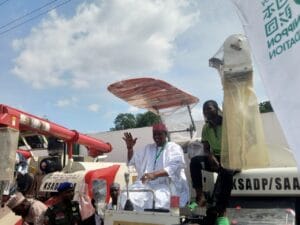
The Sasakawa Africa Association (SAA) Nigeria, in collaboration with key partners, has facilitated the deployment of 12 combine harvesters, Hijet minivans, and smart irrigation systems to Kano State as part of its efforts to enhance agricultural productivity in the region.
Wind-Flow reports that this was revealed during a two-day high-level workshop on agricultural transformation, began yesterday at the Kano State Government House.
The farm machines, funded by the Islamic Development Bank (IsDB), the Lives and Livelihood Funds (LLF), and the Kano State Government, will be utilized by the Kano State Agropastoral Development Project (KSADP) to support rural farmers in improving their farming activities.
Additionally, full welding and fabrication kits were provided to local farm equipment fabricators to further boost agricultural innovation in the state.
Speaking at the event, Dr. Amit Roy, Chairman of SAA, highlighted the importance of the initiative, stating that it reflects the growth and transformation of agricultural partnership in Nigeria.
He noted that the Sasakawa Africa Association remains committed to fostering innovation and resilience in agriculture through the adoption of new technologies.
“Today’s event marks a significant milestone in our journey towards agricultural transformation. KSADP, a collaboration between the Islamic Development Bank, Lives and Livelihoods Fund, and the Kano State Government, is a five-year project aimed at developing resilient agro-pastoral systems,” Roy said.

Hefurther emphasized that the project, which focuses on enhancing agricultural productivity by addressing challenges such as poor soil conditions and climate change, has already achieved notable success.
Dr. Makoto Kitanaka, President of SAA, reaffirmed the organization’s dedication to addressing critical issues in agriculture, including the effects of climate change and rising fertilizer prices.
He also stressed the need to prioritize the creation of employment opportunities, particularly for young men and women in the agricultural sector.
“SAA is committed to promoting agriculture and rural development across various countries. We are keen on creating opportunities in the agricultural value chain for youth and women,” Kitanaka stated.
Dr. Godwin Atser, SAA Country Director, provided further insight into the achievements of the KSADP project, which is in its fifth year.
He noted that the project has successfully enhanced the productivity and competitiveness of cereals and vegetables in Kano State, benefiting over 5,000 farmer clusters with capacity-building programs and inputs.
He also highlighted the establishment of agro-processing centers and solar drying facilities for vegetables and onions, which have empowered local communities.
“We have trained and empowered communities with starter packs and enhanced linkages between primary producers and market actors,” Atser said.
As the project continues, Sasakawa Association aims to scale and replicate its successes across other regions, further strengthening Kano’s agricultural sector and improving the livelihoods of rural farmers.
The workshop served as a platform for the stakeholders to reflect on their progress and explore future opportunities for collaboration in transforming Kano’s agriculture.
Since its establishment, Sasakawa African Association has worked in a total of 17 countries to support smallholder farmers in Africa through the strengthening of agricultural extension and advisory systems.
SAA currently has offices in 4 focus countries (Ethiopia, Nigeria, Mali, and Uganda) and is implementing field-based programs that encompass the food system from production, post- harvest handling, and agro-processing, to marketing and consumption.


