


By Abdulkarim Ibrahim
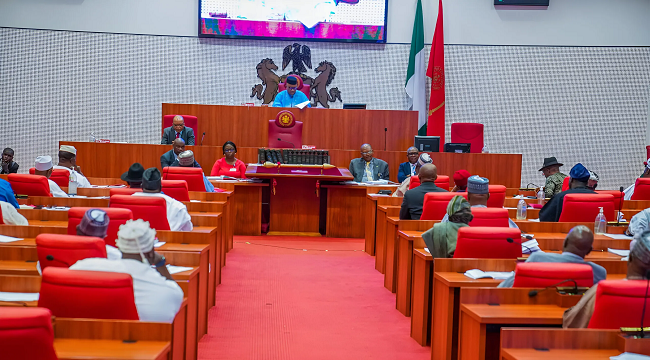
The Nigerian Senate has initiated a comprehensive probe into government agencies for alleged breaches of the federal character principle.
This investigation aims to address concerns of systemic marginalization in public sector appointments, with a focus on institutions such as the Nigerian National Petroleum Company Limited (NNPCL) and the Pension Commission (PENCOM).
The federal character principle, as outlined in Section 14(3) of the 1999 Constitution, emphasizes the need for fair representation and promotion of national unity in government agencies and institutions.
However, the Senate has raised concerns that some agencies have consistently disregarded this principle, leading to imbalances in appointments and recruitment.
To investigate these allegations, the Senate has mandated its Committee on Federal Character and Inter-Governmental Affairs to conduct thorough hearings and report back within four weeks.
During Tuesday’s plenary, lawmakers decried what they described as “institutional favoritism,” where top positions in federal agencies are dominated by select regions, disregarding the constitutional mandate for equal representation.
Leading the charge, Senator Osita Ngwu (PDP-Enugu) argued that agencies have “consistently manipulated” recruitment and promotion processes, favoring individuals from a few states while sidelining qualified candidates from underrepresented areas. “This is not just about fairness; it’s about national unity,” he stressed.
The Nigerian Senate has identified several government agencies, including the Nigerian Ports Authority (NPA), Nigeria Deposit Insurance Corporation (NDIC), and National Library of Nigeria, for violating the federal character principle. This principle aims to promote national unity and ensure equitable representation of all regions in federal appointments and resources allocation.
Lawmakers are concerned that these agencies, meant to serve the entire nation, have become elitist groups favoring specific regions. This raises questions about the fairness and inclusivity of their recruitment processes and resource distribution.
Senator Adamu Aliero, in his contribution, called for the creation of a high-powered ad hoc committee to investigate the matter.
He emphasized that the Nigerian Constitution mandates fair representation of all ethnic and religious groups in government appointments. However, he argued that recent appointments have failed to reflect this principle, leading to the domination of certain groups while others are marginalized.
“What we see today is completely different from what the Constitution stipulates. Some appointments are influenced by nepotism, sidelining other states of the federation. This Senate must act,” Aliero said.
He criticized the Federal Character Commission (FCC) for failing to enforce equitable representation, adding that commissioners from various states have repeatedly raised concerns about MDAs making appointments without their knowledge. Even when violations are reported, political interference often prevents corrective action, he noted.
To address the issue, Aliero proposed the establishment of an independent ad hoc committee, arguing that relying solely on the Senate Committee on Federal Character may not yield effective results.
“If we leave this to the Committee on Federal Character, we will not achieve the desired outcome. A high-powered committee, made up of people who can hold top government officials accountable, is needed,” he stated.
Senator Seriake Dickson called for the full implementation of Nigeria’s federal character principle to address growing concerns over ethnic imbalance in government institutions.
Dickson stressed that Nigeria’s founding fathers recognised the country’s diversity and put structures in place to ensure inclusivity.
However, he lamented that these structures, including the Federal Character Commission, have been neglected, leading to widespread marginalization.
He pointed out that in many ministries and agencies, recruitment favors certain ethnic groups to the exclusion of others, even within states. “This is not just about major tribes versus smaller ones. In some states, employment is monopolized by one local government, which is a clear violation of the Constitution,” he said.
Rejecting calls for a new committee to investigate the issue, Dickson insisted that the Senate’s existing Federal Character Committee should be empowered to carry out its mandate effectively. He urged the National Assembly leadership to engage President Bola Tinubu on the matter to ensure compliance with the Constitution.
The senator also highlighted recruitment irregularities in key institutions like the Nigerian National Petroleum Corporation (NNPC) and the Central Bank of Nigeria (CBN), calling for a review to ensure fair representation. “This is a serious issue that requires collective responsibility, not a blame game,” he said.
Dickson further recommended extending the committee’s timeframe beyond four weeks to allow for thorough investigations. He expressed hope that enforcing federal character principles would promote fairness and strengthen national unity.
Senator Victor Umeh (LP-Anambra) condemned the “deliberate exclusion” of certain zones, particularly in federal appointments and infrastructure projects. Citing the omission of the eastern rail line from the 2025 budget, he lamented, “No part of Nigeria should be treated as an afterthought.”
However, Senator Adams Oshiomhole (APC-Edo) challenged his colleagues, questioning whether the Senate itself had done enough to prevent lopsided appointments. “Who is marginalizing who?” he asked, pointing out that most top government appointments require Senate approval.
In response, the Senate directed its Committee on Federal Character and Inter-Governmental Affairs to launch an investigative hearing, with a four-week deadline to report its findings.
The outcome of the probe could set the stage for major reforms—or expose deeper fractures within Nigeria’s governance system. With public frustration over inequality in federal appointments mounting, all eyes are now on the Senate’s ability to translate its findings into tangible action.


