


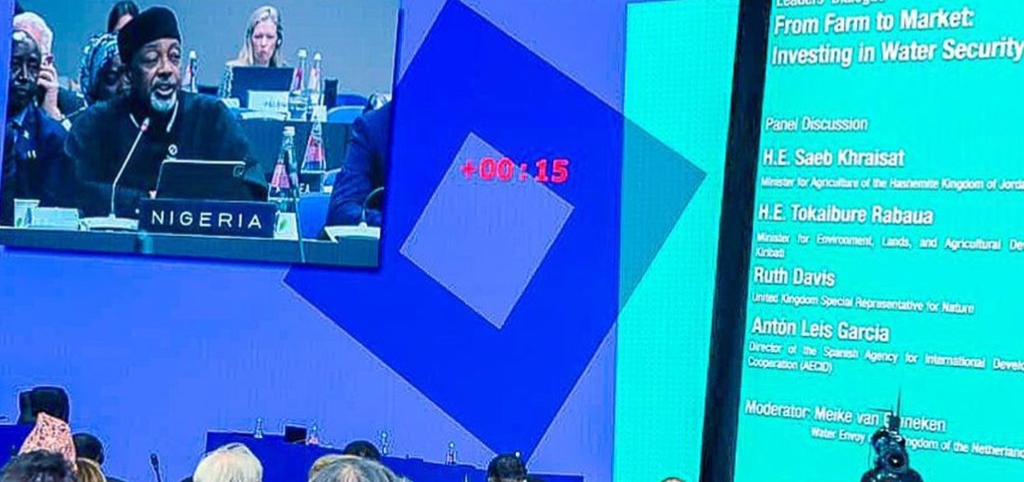
Senator Abubakar Kyari, CON, Raises Alarm On Lake Chad Crisis ayt IFAD Leaders’ Dialogue On Water Security
Senator Abubakar Kyari, CON, Nigeria’s Honourable Minister of Agriculture and Food Security and Chairman of the Governing Council of the International Fund for Agricultural Development (IFAD), has sounded a strong alarm over the deteriorating state of Lake Chad, urging immediate and coordinated global intervention. He described the shrinking lake as a grave threat to food systems, economic survival and regional stability across the Sahel and Central Africa.
Addressing world leaders at the Leaders’ Dialogue themed From Farm to Market: Investing in Water Security held at IFAD’s Plenary Hall, Kyari painted a sobering picture of environmental decline and human hardship. He noted that the once-vast Lake Chad has dramatically receded, leaving communities that depend on it increasingly vulnerable.
The Minister revealed that the lake has lost nearly 90 per cent of its surface area over the years, a decline that has intensified poverty, triggered displacement and fueled insecurity in surrounding nations. According to him, the ecological crisis has evolved into a humanitarian and security challenge with far-reaching implications.
Kyari stressed that the Lake Chad basin remains a lifeline for millions of farmers, herders and fisherfolk whose livelihoods are intricately tied to its waters. Without urgent intervention, he warned, the ripple effects on food production, rural incomes and social cohesion could deepen existing fragilities.
He called on multilateral agencies, development partners and non-governmental organisations to move beyond diagnostic reports and feasibility studies, urging them instead to embrace decisive, coordinated and adequately funded measures. He emphasized that fragmented efforts would no longer suffice in addressing a crisis of such magnitude.
Concluding his remarks, Kyari underscored that revitalizing Lake Chad is not merely an environmental ambition but a strategic investment in climate resilience, regional food security and sustainable peace. Restoring the lake, he argued, would represent a bold commitment to safeguarding the future of millions across Africa’s most climate-stressed corridor.


