

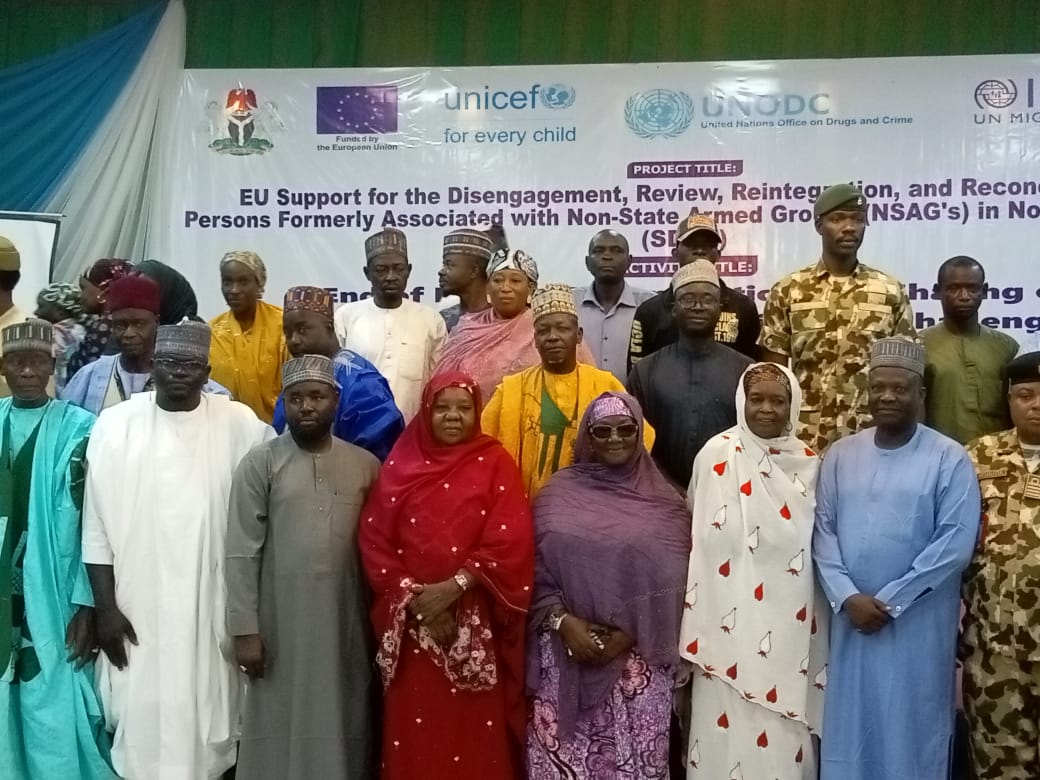
EU-Supported SD3R Project Strengthens Peace, Livelihoods in Bama, Gwoza
By Ali Mohammed Zanna, Maiduguri
The Allamin Foundation for Peace and Development, in collaboration with its partners, has concluded a six-month European Union-supported SD3R project aimed at strengthening peacebuilding, reconciliation, transitional justice, livelihood recovery and the reintegration of persons associated with non-state armed groups in Bama and Gwoza Local Government Areas of Borno State.
The project, which was implemented in two of the local government areas worst affected by the insurgency, also focused on strengthening community structures to support peaceful coexistence and the sustainable reintegration of returnees.
Speaking at the project’s closing ceremony, the Executive Director of the Allamin Foundation, Hajiya Hamsatu Allamin, said the intervention received the support and cooperation of the Borno State Government and was designed to complement ongoing government efforts towards recovery and peacebuilding.
She said the project was also aimed at sharing best practices, successes, lessons learned and challenges in the reintegration and reconciliation process.
According to her, successful reintegration cannot focus solely on returnees, stressing that the communities to which they return must be actively involved in the process.
“Reintegration and reconciliation are so important because this is where you are going to integrate them within their own society and communities,” she said.
Allamin explained that reconciliation was particularly important because some returnees were returning to communities where people had suffered oppression, abuse and other forms of violence.
She said the foundation therefore engaged traditional institutions, including the Shehu and Emirs, as well as local government authorities, before taking the intervention to the grassroots.
The intervention established community-based peace structures, including the Community Women Mediators Forum and Community Advocates for Transitional Justice (CATJ).
Allamin said 20 women were selected in each target community to form Women Mediators Forums, with the aim of increasing women’s visibility and agency and building their capacity to contribute to reconciliation.
“Women play a very prominent role in reconciliation. With knowledge and skills, these women will be able to perform wonders,” she said.
She added that the Community Dialogue Forums brought together representatives of the wider communities, including returnees, during regular meetings held every two months.
The forums provided opportunities for community members and returnees who previously found it difficult to live, travel or worship together to meet face-to-face, discuss grievances and begin rebuilding trust.
According to her, although participants initially experienced discomfort and mistrust, the dialogue gradually encouraged openness, with some returnees acknowledging their past actions and seeking forgiveness from community members.
She said the forums also provided women with an avenue to raise sensitive issues that they might otherwise be reluctant to discuss, particularly with women mediators participating in the process.
The project reached 371 direct beneficiaries and approximately 350 indirect beneficiaries, while providing 540 livelihood support items and training participants in 18 different trades.
It also supported small businesses and community savings initiatives aimed at helping beneficiaries develop sustainable sources of income and strengthen household resilience.
Allamin said the project adopted an inclusive livelihood-support model in line with the Borno State Government’s recommendation that interventions should benefit both returnees and members of their host communities.
She explained that for every returnee empowered, two community members were also supported.
“This means that when you empower 100 returnees, you empower 200 community members who are victims and others,” she said.
The project also implemented community development initiatives, including the provision of boreholes, hand pumps and drainage systems, to improve living conditions and strengthen community resilience.
Beneficiaries and traditional rulers at the closing ceremony highlighted improvements in peaceful coexistence, community dialogue, trust and the acceptance and reintegration of returnees.
Stakeholders commended the Allamin Foundation and its partners for complementing government efforts towards recovery, reconciliation and sustainable peace in the affected communities.
They, however, called for continued investment in reconciliation, transitional justice, livelihood recovery and community-led peacebuilding to sustain the gains recorded under the project.
They stressed that sustained support would be necessary to consolidate trust between returnees and host communities and achieve lasting peace in Bama and Gwoza.