

By Abdulkarim Ibrahim
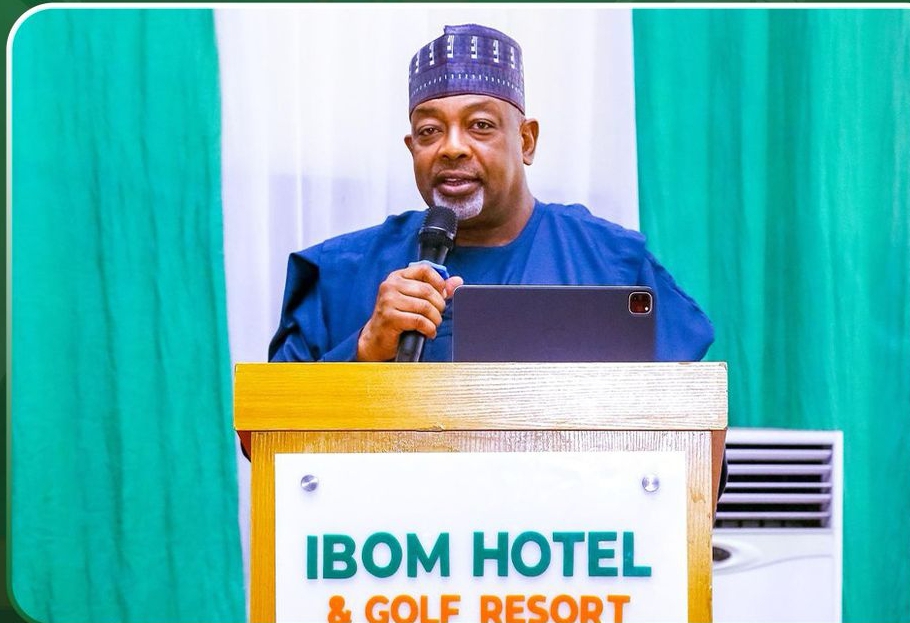
The Honourable Minister of Agriculture and Food Security, Senator Abubakar Kyari, CON, delivered a compelling paper presentation at the Revenue Mobilisation Allocation and Fiscal Commission (RMAFC) retreat held in Uyo, Akwa Ibom State, emphasizing the imperative of diversifying Nigeria’s economy through agriculture, manufacturing, industry, and tourism.
Themed “Understanding the Role of the Revenue Mobilisation Allocation and Fiscal Commission and Other Stakeholder Agencies in Nation Building,” the event convened commissioners, policymakers, and development stakeholders to explore institutional roles in Nigeria’s economic trajectory.  In his presentation titled “The Imperative of Diversification of the Nigerian Economy” Senator Kyari stressed that Nigeria must urgently reduce its dependence on oil and strengthen high-potential sectors to achieve sustainable and inclusive growth.
“Agriculture forms the foundation of our diversification strategy—engaging over 70% of our workforce and contributing 25% to GDP. Manufacturing serves as the engine for value addition and job creation, while tourism is the catalyst that can unlock rural economies and project our cultural wealth globally,” the Minister explained.
He outlined flagship programmes under the Renewed Hope Agenda of President Bola Ahmed Tinubu, GCFR, including national mechanisation initiatives with Belarus and John Deere, the Green Imperative Project with Brazil, and the National Agricultural Growth Scheme-Agro Pocket (NAGS-AP), which has supported over 600,000 farmers nationwide.
Senator Kyari also highlighted the development of Special Agro-Industrial Processing Zones (SAPZs) as a transformative bridge between agriculture and industry, and emphasized Nigeria’s growing focus on agritourism, citing the launch of Nigeria’s first Agritourism Village and the successful hosting of the 2024 World Agritourism Congress.
The Minister called for enhanced collaboration among government institutions and fiscal authorities, particularly the RMAFC, to ensure equitable resource allocation and investment in strategic non-oil sectors.
“We must invest where returns are greatest for the Nigerian people—in food systems, manufacturing value chains, and cultural capital. With the right coordination, these sectors will drive our future,” he concluded.
The presentation was well-received and contributed to ongoing conversations about aligning Nigeria’s fiscal policies with its long-term diversification goals.