

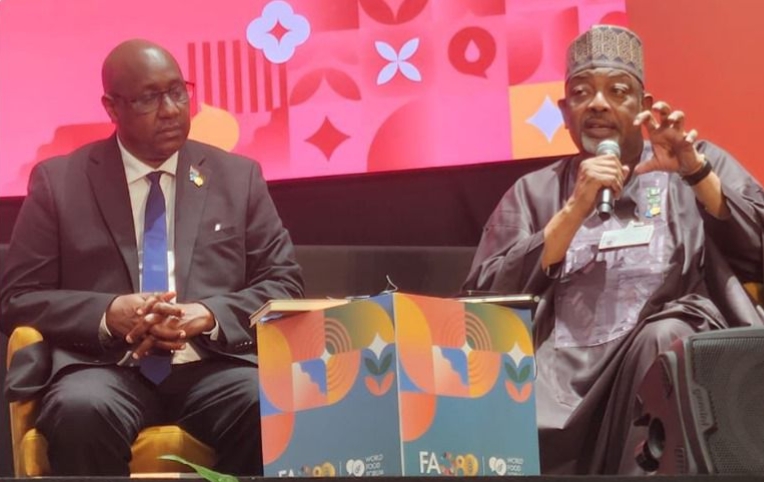
The Honourable Minister of Agriculture and Food Security of Nigeria, Senator Abubakar Kyari, CON, has emphasized the need for deeper collaboration between the public and private sectors to drive increased and better-quality investments in agrifood systems across the Sahel.
The Minister made this call while responding to a question during a high-level panel discussion at the FAO Hand-in-Hand Sahel Regional Initiative in Rome, which focused on accelerating capacity, partnerships, and investments to transform agrifood systems in the region.
When asked “what more could be done to improve public sector engagement with the private sector to stimulate more and better investments?”, Senator Kyari underscored that bridging policy gaps, improving transparency, and fostering innovative financing mechanisms are crucial to unlocking the full potential of Africa’s agriculture sector.
“Our shared challenge is clear: a fragmented investment landscape, bureaucracy in regulatory processes, and insufficient alignment between policy signals and private-sector execution. Our opportunity is equally clear: to leverage strong institutions, innovative financing, and smart governance to unlock the full potential of our farmers, processors, and agribusinesses,” he stated.
Read Also: Minister Kyari Unveils Simplified CAADP Policy, Pledges Renewed Drive For Agri-food System Reform
Using Nigeria as an example, the Minister highlighted key reforms and programmes designed to enhance private sector participation, including:
• The National Agrifood System Investment Plan (NASIP): which is being upgraded into a National Public–Private Investment Portal; a transparent digital platform showcasing bankable opportunities in mechanization, irrigation, storage, processing, logistics, and digital agrifood services.
• Streamlining Incentives: targeted investment tax and import duty reliefs to attract private sector participation, alongside risk-sharing facilities in collaboration with development partners.
• Scaling up the Special Agro-Industrial Processing Zones (SAPZ): the largest such initiative in Africa, currently being expanded from eight to twenty-seven states to provide integrated infrastructure and reduce costs for agro-processors.
• Implementing the Nigeria Post harvest Systems Transformation Programme (NiPHaST): aimed at reducing the N3.5 trillion lost annually to post harvest inefficiencies through improved storage, cold chain, and warehousing solutions.
Senator Kyari stressed that the transformation of agrifood systems requires “smart governance and unwavering political will,” assuring that under the leadership of President Bola Ahmed Tinubu, GCFR, Nigeria is committed to creating an enabling environment where investors can thrive alongside farmers.
Read Also: FAO DG, Senator Kyari Forge Alliance To Advance Agriculture and Create Jobs In Nigeria
“We will work hand in hand with FAO, IFAD, AfDB, the World Bank Group, ECOWAS, and the private sector to turn investment promises into concrete projects that feed families, create jobs, and strengthen food sovereignty,” he concluded.