

By Abdulkarim Ibrahim
President Bola Ahmed Tinubu has said there should be equity and inclusion for low-income and emerging economies in global systems.
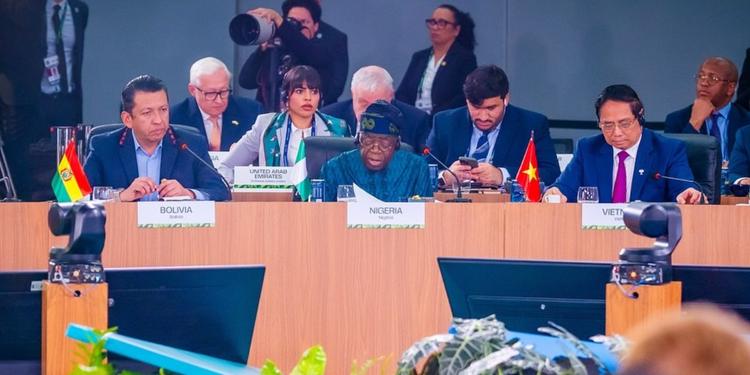
Tinubu, who made the call while speaking at the 17th BRICS summit in Rio de Janeiro, Brazil, stressed the need for greater inclusion and equity for low-income and emerging economies, especially in Africa.
He emphasised the urgency of addressing environmental degradation, the climate crisis, and healthcare disparities, which he said continue to hinder development across the Global South.
“Nigeria, therefore, associates with what I have heard today and all that has happened in BRICS,” Tinubu said, according to a statement issued by his Special Adviser on Information and Strategy, Bayo Onanuga.
“The next issues are financial restructuring and reevaluation of the global structure.”
Tinubu’s participation in the summit followed Nigeria’s recent admission as a partner country in the BRICS group, a category created during the 16th BRICS Summit in Kazan in October 2024.
Nigeria officially joined the bloc in January 2025, alongside Belarus, Bolivia, Cuba, Kazakhstan, Malaysia, Thailand, Uganda, and Uzbekistan.
Invited by Brazilian President Luiz Inácio Lula da Silva, Tinubu said that Africa must be given a stronger voice in shaping global outcomes, particularly on issues such as climate action and healthcare equity.
“Africa has contributed the least to global emissions but suffers the most,” Tinubu stated.
“We need a new path of justice, anchored in fairness, sustainable technology transfer, and accessible financing so that emerging economies can fully benefit from various initiatives.”
He cited Nigeria’s leadership in environmental efforts through the African Carbon Market Initiative and the Great Green Wall, adding that the upcoming COP-30 climate summit would be crucial in aligning strategies for a healthier planet.
The President reaffirmed Nigeria’s commitment to South-South cooperation and proactive engagement in global decision-making processes.
“We can, therefore, not be passive participants in global decision-making on financial restructuring, debt forgiveness, climate change, environmental issues, and healthcare,” he said.
“We must be the architects of a future that addresses the specific needs and concerns of youths, who represent 70 percent of our population in Nigeria.”
According to Onanuga, Tinubu highlighted Nigeria’s long-term Vision 2050 plan and efforts to advance renewable energy, nature-based solutions, urban resilience, and universal health coverage.
Addressing global health priorities, Tinubu called for a collective response to the rising burden of non-communicable diseases and stressed the need to transform BRICS into not just a bloc for emerging economies, but also a catalyst for solutions based on “solidarity, self-reliance, sustainability, and shared prosperity.”
“As we approach COP-30 and look to strengthen the global health system, we believe the BRICS must not only be a bloc for emerging economies but also a beacon for emerging solutions,” he said.
“Nigeria reaffirms its commitment to strategic collaboration that translates into sustainable and inclusive development for all.”